VDG INSIGHTS | Automotive Industry Outlook
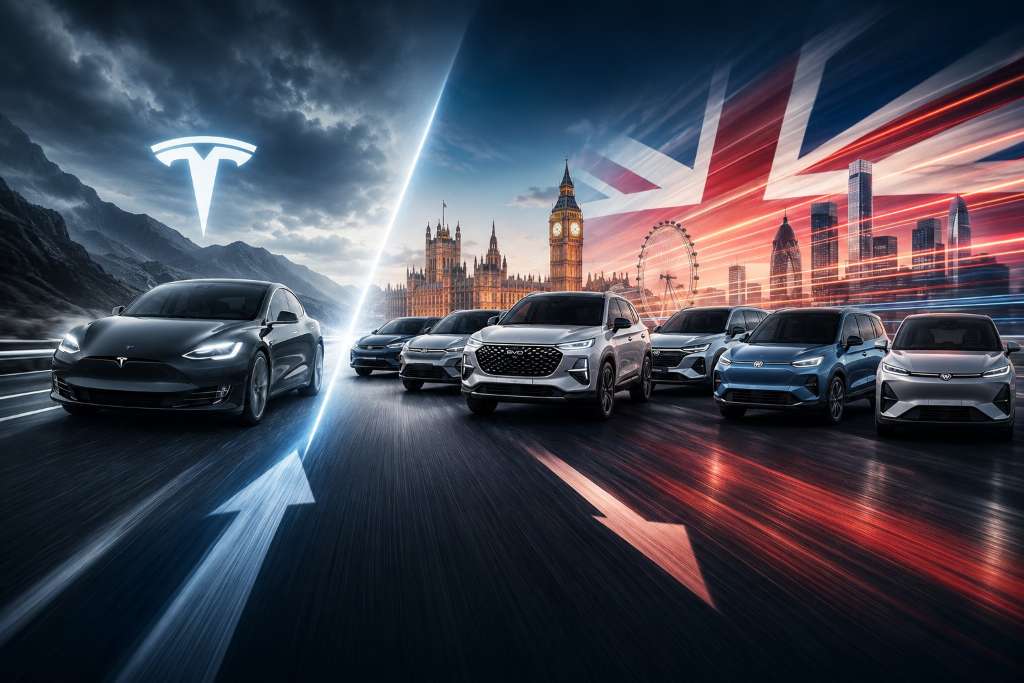
Tesla Took a Decade.
Chinese Brands Are Doing It in Months.
The UK Market Is Changing
For years, discussions around the UK automotive market have focused on the rise of Tesla, the gradual transition to electric vehicles and the influence of European manufacturers. Today, Chinese brands are reshaping the industry and rapidly increasing their presence within the market, accounting for over 10% of overall market share, with more than 200,000 Chinese vehicles sold in 2025.
What is most striking is the speed at which consumers have adapted. Typically, new automotive brands have taken decades to establish meaningful market share within the UK. Chinese brands, however, have achieved significant scale in just a handful of years. This growth has not been driven by a single manufacturer, but by a wave of brands targeting different demographics, price points and vehicle segments.
Tesla Built the EV Market
Many will say that Tesla built the path for the EV market we have today. When Tesla entered the market, electric vehicles remained a niche product, with many concerns around battery range, long-term reliability and charging infrastructure. For many consumers, electric vehicles were perceived as expensive and impractical, with many unconvinced that they were a genuine alternative to traditional petrol and diesel vehicles.
However, while Tesla changed that perception for many, building a market and dominating it are two very different challenges.
While Tesla's growth in the UK was significant, it was also gradual. The company spent around a decade building trust, overcoming scepticism and convincing mainstream consumers that Tesla was a viable alternative to traditional combustion engine vehicles. The challenges Tesla faced over many years helped create the conditions that newer entrants now benefit from.
This creates a particularly interesting dynamic. Tesla played a crucial role in building the UK's EV market, while newer competitors are entering an environment where many of the biggest challenges and consumer concerns have already been addressed.
As a result, newer competitors can focus on innovation, product range, pricing and market share growth, rather than trying to convince consumers that their vehicles are worth considering in the first place. This is one of the main reasons brands such as BYD have been able to grow at such a pace. Tesla may have laid the foundations, but others are now looking to capitalise on them.
The Rise of Chinese Brands
BYD's acceleration into the UK market has been one of the most unexpected shifts, taking just under two years to gain around 2% of UK market share and rising from 0.45% in 2024 to 2.55% by the end of 2025. BYD's product strategy is much broader, offering a growing range of vehicles across multiple segments and price points. This has allowed the brand to appeal to a wider audience, not only first-time EV buyers, but also consumers seeking SUVs, which have become increasingly demanded within the UK market. BYD has demonstrated how quickly Chinese manufacturers can gain traction in an already established market.
While BYD has increased competitiveness and challenged Tesla, Jaecoo is another example of a brand gaining significant traction in a short period of time. Reports suggest that Jaecoo achieved around 2% market share within just nine months of launching in the UK, with over 33,000 registrations in its first year of trading from January 2025 to January 2026. This could make it one of the most successful automotive launches in recent memory. Beyond this, in new 2026 registrations, the Jaecoo 7 was the most popular registered vehicle, with over 7,000 new registrations compared to just over 700 in the same period in 2025.
There is often a misconception that the growth of Chinese brands is being driven solely by the transition to electric vehicles. However, Jaecoo has been able to reach a wider audience by offering a product range that includes traditional petrol powertrains, plug-in hybrids and fully electric vehicles. By offering multiple powertrains, Jaecoo can meet consumers wherever they are on their electrification journey. Whether consumers have entered that journey or not, they are still able to access the brand through hybrid or traditional offerings, strengthening the brand's position within the market.
Not only that, Jaecoo has also targeted mainstream motorists who want a well-equipped SUV at a competitive price. This has placed Jaecoo in competition with some of the UK's most well-established brands. Rather than targeting Tesla directly, it is also competing for customers who may have previously considered vehicles such as the Kia Sportage, Volkswagen Tiguan or even the Range Rover Evoque.

The Real Threat Isn't One Brand
The real threat is not individual brands like BYD and Jaecoo. Chinese manufacturers are creating an ecosystem of brands entering the UK market simultaneously, each targeting different segments, price points and powertrain preferences.
With that, no single brand is directly targeting established manufacturers like Tesla. Instead, as a whole, they are creating a far bigger impact than probably ever imagined.
MG became established within the UK market, proving that Chinese owned manufacturers can achieve mainstream acceptance. BYD entered the UK market, targeting electric vehicle consumers and challenging Tesla as a leading EV brand. Jaecoo and Omoda have expanded further, targeting the SUV segments, while still providing that premium style with competitive pricing. Now GAC's AION brand has officially launched in May 2026 within the UK, further expanding the presence of Chinese brands within the UK automotive market.
What makes all these brands particularly interesting is the diversity they collectively hold for competitive threat, all the while they do not compete with each other for the same customers. Together, they are reshaping the competitive landscape of the UK automotive market.
Why This Matters Beyond Tesla
Chinese manufacturers are proving that success in the UK no longer requires a decade of brand-building and market education. Under the right conditions, meaningful market share can be achieved in a fraction of the time. While Tesla demonstrated that a new automotive brand could successfully enter the market and create disruption, Chinese manufacturers are now demonstrating that multiple new brands can scale simultaneously.
Chinese brands currently account for over 10% of the UK market, and that share continues to grow. The question is no longer whether Chinese manufacturers can establish themselves within the UK, but how much further they can expand. As the market continues to evolve throughout 2026, it will be interesting to see whether established manufacturers can defend their positions by adapting quickly enough to an increasingly competitive landscape.